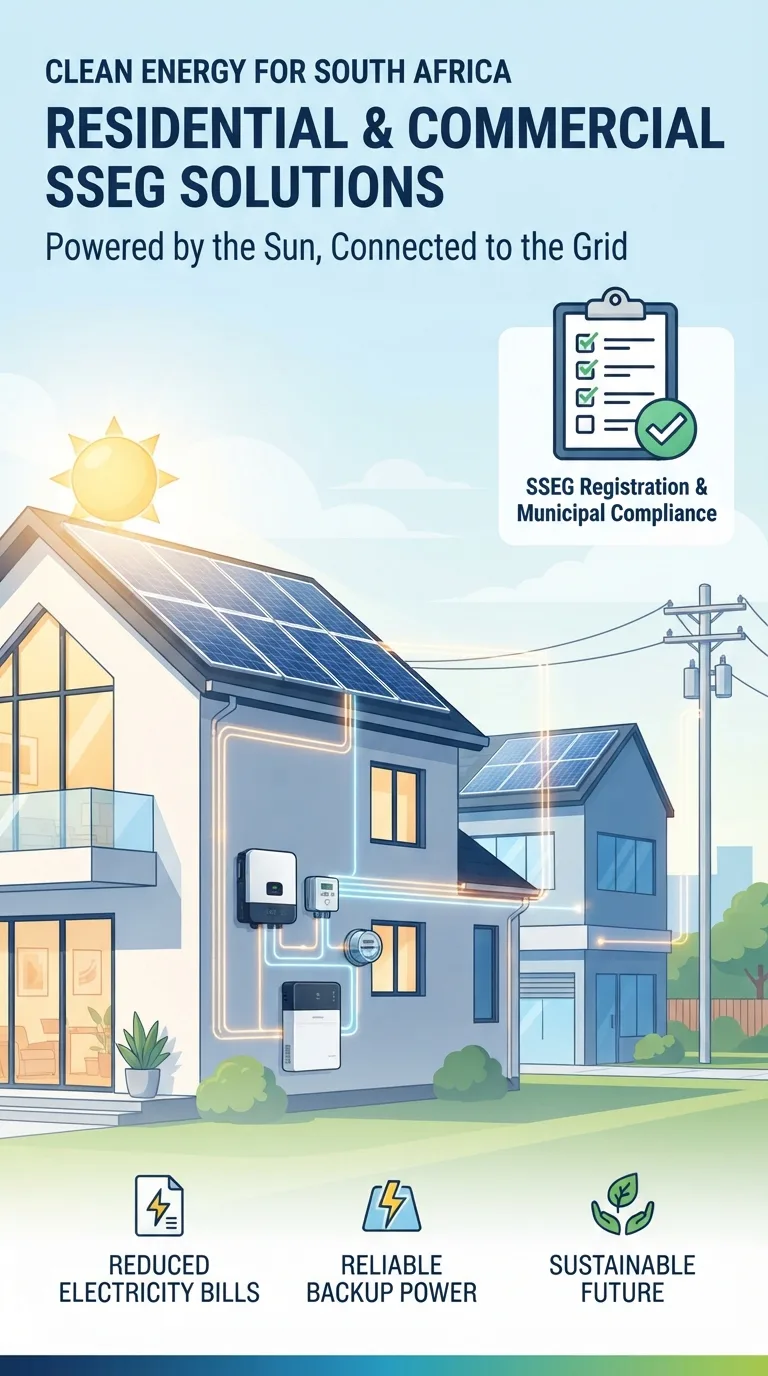
Mandatory Compliance for Grid-Tied Solar Systems
As solar and backup power installations continue to grow across South Africa, compliance with Small-Scale Embedded Generation (SSEG) regulations has become a top priority for property owners, body corporates, and commercial portfolio managers.
Under the Electricity Regulation Act, National Energy Regulator of South Africa (NERSA) rules, and local municipal by-laws, every solar or hybrid inverter system connected in parallel to the electrical grid under 1 MVA must be registered with the relevant electricity distributor—whether that is Eskom Direct or a local municipality such as the City of Ekurhuleni or City Power.
Crucially, zero-export systems are not exempt. Even if an inverter is configured never to feed excess power back into the grid, it remains synchronized with the utility network and requires formal SSEG approval. Only true off-grid installations that are physically isolated from the municipal or Eskom supply are exempt from SSEG registration, though they must still hold a valid SANS 10142-1 Certificate of Compliance (CoC).
Eskom Extends Fee Waiver Indefinitely
Following significant industry pushback and earlier amnesty deadlines in March and September 2026, Eskom officially scrapped its cutoff date on 1 October 2026 and extended its SSEG registration fee waiver indefinitely until further notice.
For Eskom Direct customers with systems up to 50 kVA, this means:
Zero registration and connection fees (saving property owners up to R10,000 in urban areas and R36,000 in rural zones).
Simplified sign-off requirements, where a Certificate of Compliance from a Department of Employment and Labour (DoEL) registered electrician is accepted instead of an expensive ECSA engineer sign-off for smaller residential and light-commercial systems.
While Eskom has removed its deadline, local municipalities operate under their own independent by-laws and tariff structures. Failing to register a grid-tied system with a local metro can still expose property owners to municipal fines ranging from R6,000 to R30,000, potential disconnection fees, and rejected insurance claims in the event of an electrical fire or surge.
Key Requirements for a Smooth Application
Whether you are registering a single residential backup system or bringing a multi-tenant commercial property portfolio into compliance, preparing the right documentation prevents costly delays:
Confirm Your Electricity Supplier: Verify whether the site is billed directly by Eskom or a local municipality, as application portals and technical requirements differ.
Verify Approved Equipment: Ensure all inverters are listed on your utility's approved NRS 097-2-1 list.
Secure Valid Certification: Obtain an updated Electrical Certificate of Compliance (CoC) alongside any required Single Line Diagrams (SLDs) or ECSA-registered Professional Engineer sign-offs for larger commercial capacities.
Additional NERSA Licensing: Note that commercial systems exceeding 100 kW require formal registration with NERSA in addition to municipal or Eskom approval.
Need Assistance With SSEG Compliance and Sign-Offs?
Navigating municipal portals, Single Line Diagrams, and engineering sign-offs can be complex—especially across commercial and industrial sites.
At HT Energy, our team—led by an ECSA-registered Professional Engineer, a Master Electrician, and licensed installation electricians—assists property managers, businesses, and homeowners across Gauteng with full SSEG applications, compliance audits, and electrical upgrades.
Contact HT Energy today to ensure your solar and backup power installations are fully certified, insured, and compliant.
Have a project in mind?
Speak to a product specialist about your energy, electrical or refrigeration needs.
Get in touch